
Why Pretend Play Is Crucial for Kids: Screen-Free Learning Powered by Imagination

Walk into any playroom and you might find a dragon guarding the couch, a chef serving invisible soup, or a wizard casting spells with a wooden spoon. It looks like silliness. It's actually some of the most important work a child does.
At Wonderstruck Camp and Events in Toronto and Etobicoke, we spend our days among woodland elves, garden fairies, and deep-sea mermaids, so we've seen what happens when kids are given room to imagine. Imagination isn't the opposite of learning. It's the foundation for resilience, hope, confidence, and self-esteem, the qualities that help kids grow into self-assured adults. And the best part? It's learning outside a screen!
Imagination builds resilience.
When life gets hard, getting through it takes more than grit. It takes the ability to picture things getting better. A child who can imagine a different outcome is a child who can make the choices that lead there. Education expert Herbert Kohl has pointed out that imagination doesn't just copy the world as it is; it dreams up other possible worlds, and that opening of possibility is where hope comes from.
Pretend play is where kids practice this. Every time a child decides the bridge is out and invents a way to cross it, they're building a resource they can draw on for the rest of their lives.
Hope is a real-world skill.
Hope isn't just positive thinking. Psychologists describe it as an active process, grounded in reality, that requires effort. Optimists see the glass as half full; hopeful people ask how to fill it. Researchers have linked hope to stronger social and emotional skills and to better academic outcomes, including staying in school and succeeding both in and out of it.
So when we say the future belongs to dreamers, we mean it literally. Learning to imagine is a life skill that opens the door to hope, and hope opens the door to action.
Imagining success helps create it.
We've all heard "if you can dream it, you can do it." It's not quite true, and pretending otherwise ignores the real barriers many people face. But visualization is a proven tool. Athletes build confidence and self-belief by picturing success, and that mental state affects how they perform.
Believing a better future is possible leads to small daily decisions, which become habits, which can change a life. Pretend play flexes the mental muscles that make this kind of imagining possible, helping kids grow into youth who set goals and adults who achieve what success means to them.
Confident kids trust themselves.
Confidence isn't feeling great about yourself all the time. Self-confidence means accepting where you are and believing you have, or can find, the tools to get where you want to go. Self-esteem overlaps with it but is its own thing: the value you place on yourself. Kids who have it can try again after they fail and cope with mistakes.
Self-confidence isn't handed to kids; it's built, and pretend play is one of the best places to build it. When children invent their own solutions to problems that matter to them, they practice trusting themselves. Make-believe lets them try, stumble, and try again in a safe space, picturing themselves overcoming obstacles while they're the ones in charge of the story.
There's even evidence that a positive inner outlook shapes real-world outcomes. In a well-known study of 180 nuns, those who wrote more positive letters in their youth lived almost ten years longer on average than those who wrote more negative ones.
Why does screen-free matter?
Screens often hand kids a story that's already finished. Open-ended play asks them to write their own. Without screens, there's no script: children invent the rules, play every role, and decide what happens next. That's exactly the kind of mental workout that builds the skills above.
You don't need to ban screens to make room for this. Even a little more unstructured, imaginative time makes a difference. A blanket cape, a cardboard box spaceship, or a "quest of the day" with household items is plenty.
And if joining in feels a little awkward, you're not alone. In this Good Inside episode, Dr. Becky explains how pretend play nurtures curiosity, problem solving, and emotional growth, and reassures parents that finding it hard to play along doesn't make you a bad parent.
Easy ways to spark pretend play at home:
You don't need fancy toys or a big plan. The simplest setups often lead to the longest, most creative play. Here are a few ways to get started:
Build a prop box. Fill a bin with scarves, hats, old kitchen tools, and cardboard tubes. Everyday objects can become wands, crowns, or treasure maps.
Try a potion kit. You can use ready-made kits like these from The Little Potion Co. or Les Petits Sorciers, or you can simply make your own with some vinegar, baking soda, food colouring, and anything else your kids find outdoors!
Offer a story starter. Try, "You find a mysterious door at the back of the park..." and see where they take it.
Play a quest of the day. Hand over a short list of household items to find, like a spoon for stirring potions or a flashlight for a dark forest.
Join in, then step back. Take a small role, like the shopkeeper or the sidekick, and let your child lead the story.
It's perfectly fine if play looks messy or changes direction halfway through. That's the imagination at work. Ten or fifteen minutes of screen-free make-believe can be enough to get a child going, and they'll often carry the story on long after you've stepped away.
And don't worry about doing it perfectly. Kids aren't looking for a polished performance. They're looking for someone to be curious alongside them, and a willingness to say "yes, and..." to a dragon on the couch goes a long way.
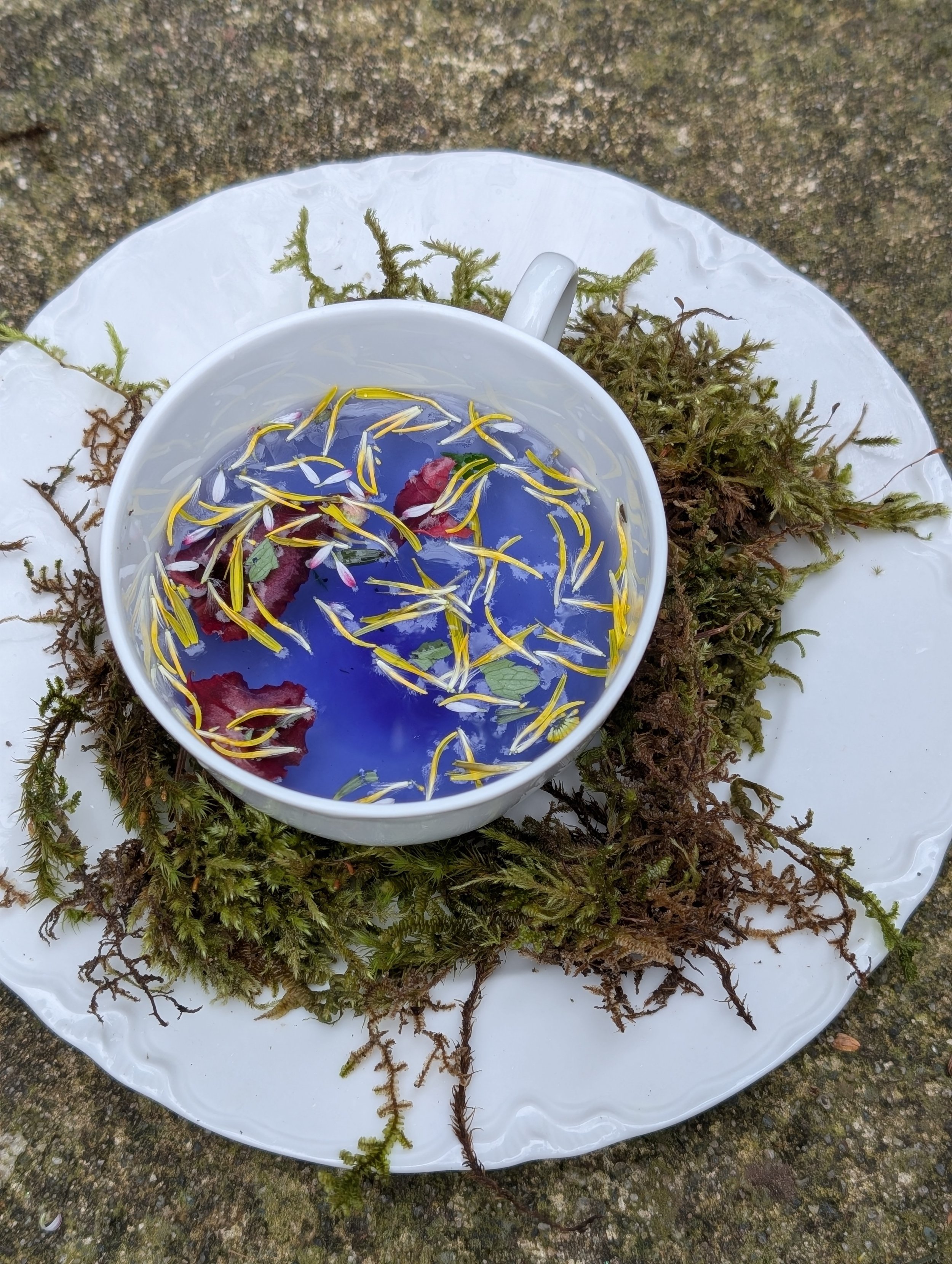
Potions can be beautiful!
Make potions with anything you find in the great outdoors!
Bring the magic to life with Wonderstruck.
At Wonderstruck, imagination is the main event. Our summer camps, PD Day camps, March Break camps, and birthday and event programs open up spaces where kids step into magical worlds and build real skills through potions, pretend play, and fantasy adventures. Our staff become characters, like deep-sea mermaids and Dawnwhisper fairies, to draw every child into the story.
When we say dreams are our power, we mean it.
Frequently Asked Questions:
What ages is camp for?
Wonderstruck campers are aged 5 to 10. Youth aged 11 to 13 can join us as Leaders in Training (LITs).
What are the camp hours?
Camp runs from 9am to 4pm. Before and aftercare (8:30am to 5pm) is available for a $10 surcharge on PD Days.
Where are your Etobicoke camps held?
Our Etobicoke camps take place at Royal York United Church, 851 Royal York Road, Toronto, ON, M8Y 2V3.
How is Wonderstruck different from other camps?
Wonderstruck is a safe, welcoming community for dreamers, creative kids, and anyone who loves a bit of adventure. Through arts and crafts, skits, and large group games, campers advance the plot of a fantasy story while growing their problem-solving, collaboration, and self-expression. Imagine a weeklong scavenger hunt inside your favourite fantasy adventure book. That's Wonderstruck.
Is camp a good fit for my family?
Expect your camper to spend a good part of the day outdoors and to take part in supervised, healthy risk-taking, from forest runs to climbing adventures. Campers should be able to follow directions and safety guidelines, participate positively in the camp community, and use the restroom independently. If your child needs extra support, reach out to us before registering.
Do your staff have first aid training and police checks?
There are staff or volunteers on site with first aid training during regular camp hours, and all staff working with campers are required to have police checks. We do not administer medications.
When do I have to pay?
A non-refundable deposit of $50 per registration is included in the cost at the time of registration. Your registration is complete once we receive payment, not just once the Camper Registration Form is filled out. If you'd like to pay in instalments, send us an email at wonderstruck.gta@gmail.com.
Do you run birthday parties?
Yes! We can host at your home or a third-party venue, and we bring the entertainment and all supplies to enchant your next milestone celebration.
Registration is now open for our PD Day camps on November 20. Spots are limited, so register today at wonderstruck.ca and give your child a day of enchanted, screen-free adventure.
